Current issue
Online First
Archive
Instructions for Authors
Guide for Authors
Peer Review Policy
Research Ethics Policy
Crossmark Policy
Ghostwriting and Guest Authorship
Copyright
Open Access Policy
Plagiarism
Preprints policy
About the Journal
Aim and Scope
Scientific Board
Publisher
Editorial Board
Indexing in Databases
Personal Data Protection
Repository Policy
AI Policy
Contact


ORIGINAL PAPER
Technical and Economic Assessment of a Residential PV-Battery System: A 12-Month Empirical Case Study with Meteorological Validation
1
Katedra Inżynierii Bioprocesów, Energetyki i Automatyzacji, Uniwersytet Rolniczy w Krakowie, Poland
Submission date: 2026-04-14
Final revision date: 2026-06-09
Acceptance date: 2026-06-10
Online publication date: 2026-06-19
Publication date: 2026-07-01
Corresponding author
Tomasz Szul
Katedra Inżynierii Bioprocesów, Energetyki i Automatyzacji, Uniwersytet Rolniczy w Krakowie, Balicka 116B, 30-149, Kraków, Poland
Katedra Inżynierii Bioprocesów, Energetyki i Automatyzacji, Uniwersytet Rolniczy w Krakowie, Balicka 116B, 30-149, Kraków, Poland
Journal of Research and Applications in Agricultural Engineering 2026;71(1):65-75

KEYWORDS
photovoltaic self-consumptionbattery energy storage LiFePO₄self-sufficiencynet-billingprosumerseasonal mismatchPVGIS validationelectric vehicle chargingcase study Poland
TOPICS
ABSTRACT
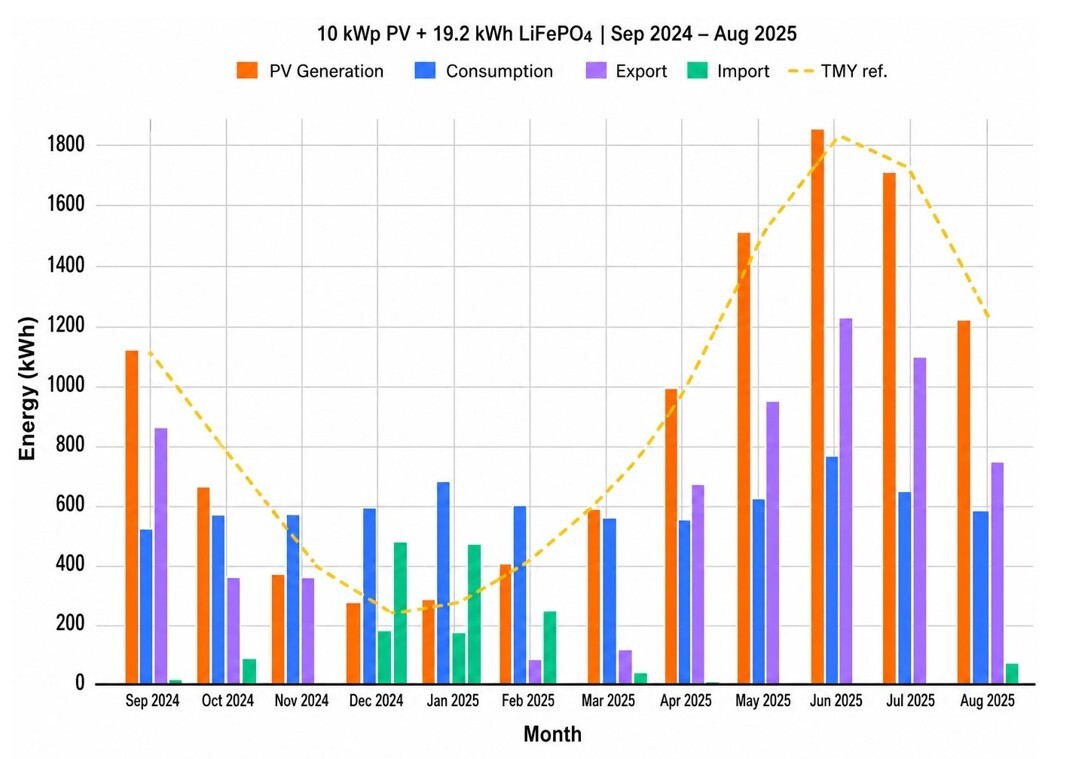
This paper presents a single-site empirical case study — formulated without claims to statistical generalisability — of a 10 kWp photovoltaic (PV) system coupled with a 19.2 kWh lithium iron phosphate (LiFePO₄) battery storage unit, based on 365 days of operational data from a single-family household in southern Poland (50.06°N; 19.94°E). The system was commissioned in August 2024; the battery was pre-charged to approximately 80% SOC prior to the monitoring period commencing 1 September 2024, ensuring that the initial SOC condition is documented and that the annual energy balance closes with negligible net change in stored energy. Standard-ised performance indicators — Self-Consumption Rate (SCR), Self-Sufficiency Rate (SSR), Equivalent Full Cycles per Year (EFC/year), and Grid Dependency Index (GDI) — are deter-mined at daily and monthly resolution. Measured annual PV yield (882.7 kWh/kWp) is com-pared with PVGIS TMY reference data (915.4 kWh/kWp), confirming that the monitoring period was characterised by irradiation approximately 3.6% below the long-term mean. The system achieved annual SCR = 46.2% and SSR = 80.9%, with complete grid independence on 70.1% of days. Battery round-trip efficiency of 91.1% confirms technical quality, while EFC ≈ 96.6 cy-cles/year indicates significant underutilisation of cycling capacity relative to the rated 6,000-cycle lifetime. Economic analysis indicates a battery-specific simple payback period of approximately 26–32 years (sensitivity range) under current Polish net-billing tariffs, identifying uncontrolled electric vehicle (EV) charging as the principal disruptor of system balance. The results constitute empirical evidence relevant for validating simulation models and provide observations useful for the design of residential energy storage systems in continental European climates.
REFERENCES (20)
1.
European Commission. REPowerEU plan (COM(2022) 230 final). 2022. https://eur-lex.europa.eu/lega....
2.
Solar Power Europe. European market outlook for solar power 2024–2028. Brussels, 2024.
3.
Luthander R., Widén J., Nilsson D., & Palm J.: Photovoltaic self-consumption in buildings: A review. Applied Energy, 2015, 142, 80–94. https://doi.org/10.1016/j.apen....
4.
Olczak P.: Magazynowanie energii elektrycznej w prosumenckich mikroinstalacjach fotowoltaicznych. Wydawnic-two IGSMiE PAN, 2022.
5.
Lis S., Szul T., Krilek J., et al.: Ocena efektywności ekonomicznej zastosowania magazynu energii w instalacji fo-towoltaicznej pracującej w ramach programu Prosument. Przegląd Elektrotechniczny, 2022, 1, 92–95. https://doi.org/10.15199/48.20....
6.
Filipiak M., Nawrowski R., Kurz D. & Pierzchała R.: Analiza opłacalności stosowania instalacji fotowoltaicznej we współpracy z magazynem energii dla domu jednorodzinnego. Przegląd Elektrotechniczny, 2022, 98(11). https://doi.org/10.15199/48.20....
7.
Dai C., Ma T., Zhang Y., Weng S., & Peng J.: Improvement of building energy flexibility with PV battery sys-tem based on prediction and load management. Building Simulation, 2024, 18(1), 65–85. https://doi.org/10.1007/s12273....
8.
Quoilin S., Kavvadias K., Mercier A., Pappone I. & Zucker A.: Quantifying self-consumption linked to solar home battery systems: Statistical analysis and economic assessment. Applied Energy, 2016, 182, 58–67. https://doi.org/10.1016/j.apen....
9.
Branchetti S., Petrovich C.; Gessa N., D’Agosta G.: Improvement of self-consumption rates by cogeneration and PV production for renewable energy communities. Electronics, 2025, 14(9), 1755. https://doi.org/10.3390/electr....
10.
Nyholm E., Goop J., Odenberger M. & Johnsson F.: Solar photovoltaic-battery systems in Swedish households: Self-consumption and self-sufficiency. Applied Energy, 2016, 183, 148–159. https://doi.org/10.1016/j.apen....
11.
Hesse H., Martins R., Musilek P. & Naumann V.: Economic optimization of component sizing for residential bat-tery storage systems. Energies, 2017, 10(6), 835.10.3390/en10070835.
12.
Yang H. & Lu L.: The optimum tilt angles and orientations of PV claddings for BIPV applications. Journal of Solar Energy Engineering, 2007, 129(2), 253–255.10.1115/1.2212439.
13.
Hernández J. C., Sanchez-Sutil F. & Muñoz-Rodríguez F. J.: Design criteria for the optimal sizing of a hybrid en-ergy storage system in PV household-prosumers to maximize self-consumption and self-sufficiency. Energy, 2019, 186, 115827. https://doi.org/10.1016/j.ener....
14.
Munkhammar J., Grahn P. & Widén J.: Quantifying self-consumption of on-site photovoltaic power generation in households with electric vehicle home charging. Solar Energy, 2013, 97, 208–216. 10.1016/j.solener.2013.08.015.
15.
Mulleriyawage U. G. K. & Shen W. X.: Optimally sizing of battery energy storage capacity by operational optimi-zation of residential PV-battery systems: An Australian household case study. Renewable Energy, 2020, 160, 852–864. https://doi.org/10.1016/j.rene....
16.
Zdonek I., Tokarski S., Mularczyk A. & Turek M.: Evaluation of the program subsidizing prosumer photovoltaic sources in Poland. Energies, 2022, 15(3), 846. https://doi.org/10.3390/en1503....
17.
Drews A., Beyer H. G. & Rindelhardt U.: Quality of performance assessment of PV plants based on irradiance data from nearby stations. Solar Energy, 2008, 82(11), 1067–1075.10.1016/j.solener.2008.04.009.
18.
Linssen J., Stenzel P. & Fleer J.: Techno-economic analysis of photovoltaic battery systems and the influence of different consumer load profiles. Applied Energy, 2017, 185(1), 2019–2025. https://doi.org/10.1016/j.apen....
19.
European Commission, Joint Research Centre (JRC). PVGIS user manual (Version 5.2), 2022. https://re.jrc.ec.europa.eu/pv....
20.
IMGW-PIB. Rocznik klimatyczny Polska 2024/2025. Instytut Meteorologii i Gospodarki Wodnej, Warszawa, 2025.
| eISSN: | 2719-423X |
| ISSN: | 1642-686X |

We process personal data collected when visiting the website. The function of obtaining information about users and their behavior is carried out by voluntarily entered information in forms and saving cookies in end devices. Data, including cookies, are used to provide services, improve the user experience and to analyze the traffic in accordance with the Privacy policy. Data are also collected and processed by Google Analytics tool (more).
You can change cookies settings in your browser. Restricted use of cookies in the browser configuration may affect some functionalities of the website.
You can change cookies settings in your browser. Restricted use of cookies in the browser configuration may affect some functionalities of the website.
