Current issue
Online First
Archive
Instructions for Authors
Guide for Authors
Peer Review Policy
Research Ethics Policy
Crossmark Policy
Ghostwriting and Guest Authorship
Copyright
Open Access Policy
Plagiarism
Preprints policy
About the Journal
Aim and Scope
Scientific Board
Publisher
Editorial Board
Indexing in Databases
Personal Data Protection
Repository Policy
AI Policy
Contact


ORIGINAL PAPER
Non-Invasive Electrical Detection of Screw Wear in an Industrial Extrusion System

1
Faculty of Environmental and Mechanical Engineering, Department of Biosystems Engineering, Poznań University of Life Sciences, Poland
2
Division of Agricultural and Forest Machines Development, Łukasiewicz Research Network - Poznań Institute of Technology, Poland
These authors had equal contribution to this work
Submission date: 2026-02-12
Final revision date: 2026-02-23
Acceptance date: 2026-03-27
Online publication date: 2026-04-16
Publication date: 2026-07-01
Corresponding author
Karol Durczak
Faculty of Environmental and Mechanical Engineering, Department of Biosystems Engineering, Poznań University of Life Sciences, Wojska Polskiego 50, 60-627, Poznań, Poland
Faculty of Environmental and Mechanical Engineering, Department of Biosystems Engineering, Poznań University of Life Sciences, Wojska Polskiego 50, 60-627, Poznań, Poland
Journal of Research and Applications in Agricultural Engineering 2026;71(1):58-64

KEYWORDS
electrical condition monitoringnon-invasive diagnosticsindustrial extrusion systemsscrew wear detectionmotor current signature analysiscondition-based maintenance
TOPICS
ABSTRACT
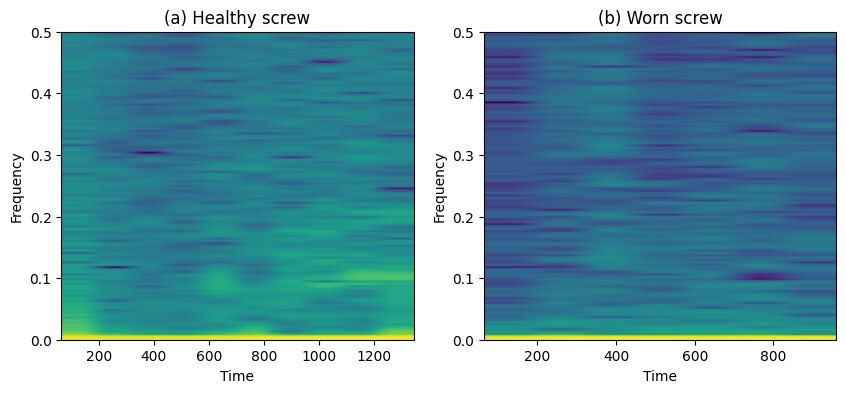
Reliable detection of mechanical wear is essential for maintaining operational stability and reducing unplanned downtime in industrial extrusion systems. This study investigates non-invasive detection of screw wear using operational electrical measurements acquired from a single-screw industrial extruder. Electrical parameters were recorded under steady-state processing conditions for healthy and worn screw configurations to determine whether measurable differences in electromechanical behavior could support condition assessment. The collected signals were segmented into 1429 labeled samples and evaluated using statistical and time–frequency analyses. Mean electrical parameters were compared between technical states, and independent samples Welch t-tests confirmed statistically significant differences in phase voltage for all monitored phases (p < 0.001). Continuous wavelet transform was applied to capture non-stationary signal characteristics, enabling extraction of energy- and entropy-based descriptors associated with variations in mechanical load. The derived features were subsequently used for automated classification of machine condition. The results revealed consistent increases in phase voltage for the worn screw ranging from 0.50% to 0.61%, indicating a stable shift in the electrical operating characteristics of the drive system. Supervised classification achieved an accuracy of 96.2% (289 of 300 samples correctly classified in the testing subset), demonstrating reliable separability between technical states without the need for additional vibration instrumentation. These findings confirm that operational electrical signals provide diagnostically relevant information for screw wear detection and support scalable implementation of electrical condition monitoring in industrial extrusion systems.
REFERENCES (19)
1.
Benbouzid M.E.H.: A review of induction motors signature analysis as a medium for faults detection. IEEE Trans-actions on Industrial Electronics, 2000, 47(5), 984–993. https://doi.org/10.1109/41.873....
2.
Blödt M., Granjon P., Raison B., Rostaing G.: Models for bearing damage detection in induction motors using stator current monitoring. IEEE Transactions on Industrial Electronics, 2008, 55(4), 1813–1822.https://doi.org/10.1109/TIE.20....
3.
Danielak M., Witaszek K., Ekielski A., Żelaziński T., Dudnyk A., Durczak K.: Wear detection of extruder ele-ments based on current signature by means of a continuous wavelet transform. Processes, 2023, 11(11), 3240.https://doi.org/10.3390/pr1111....
4.
Ekielski A., Żelaziński T., Durczak K.: The use of wavelet analysis to assess the degree of wear of working ele-ments of food extruders. Eksploatacja i Niezawodnosc – Maintenance and Reliability, 2017, 19(4), 560–564.https://doi.org/10.17531/ein.2....
5.
Diversi R., Lenzi A., Speciale N., Barbieri M.: An autoregressive-based motor current signature analysis approach for fault diagnosis of electric motor-driven mechanisms. Sensors, 2025, 25(4), 1130. https://doi.org/10.3390/s25041....
6.
Pietrzak P., Wolkiewicz M.: Application of Spectral and Wavelet Analysis of Stator Current to Detect Angular Misalignment in PMSM Drive Systems. Power Electronics and Drives, vol. 6, no. 1, Wroclaw University of Science and Technology, 2021, pp. 42-60.. https://doi.org/10.2478/pead-2....
7.
Jastrzebski R.P., Hynynen K.M., Smirnov A.: H∞ control of active magnetic suspension. Mechanical Systems and Signal Processing, 2010, 24(4), 995–1006. https://doi.org/10.1016/j.ymss....
8.
Jardine A.K.S., Lin D., Banjevic D.: A review on machinery diagnostics and prognostics implementing condition-based maintenance. Mechanical Systems and Signal Processing, 2006, 20(7), 1483–1510.https://doi.org/10.1016/j.ymss....
9.
Lei Y., Lin J., He Z., Zuo M.J.: A review on empirical mode decomposition in fault diagnosis of rotating machin-ery. Mechanical Systems and Signal Processing, 2013, 35(1–2), 108–126. https://doi.org/10.1016/j.ymss....
10.
Lei Y., Yang B., Jiang X., Jia F., Li N., Nandi A.K.: Applications of machine learning to machine fault diagnosis: A review and roadmap. Mechanical Systems and Signal Processing, 2020, 138, 106587.https://doi.org/10.1016/j.ymss....
11.
Liu R., Yang B., Zio E., Chen X.: Artificial intelligence for fault diagnosis of rotating machinery: A review. Me-chanical Systems and Signal Processing, 2018, 108, 33–47. https://doi.org/10.1016/j.ymss....
12.
Peng Z.K., Chu F.L.: Application of the wavelet transform in machine condition monitoring and fault diagnostics: A review with bibliography. Mechanical Systems and Signal Processing, 2004, 18(2), 199–221.https://doi.org/10.1016/S0888-....
13.
Quatrini E., Costantino F., Di Gravio G., Patriarca R.: Condition-based maintenance—An extensive literature review. Machines, 2020, 8(2), 31. https://doi.org/10.3390/machin....
14.
Zarei J., Poshtan J.: Bearing fault detection using wavelet packet transform of induction motor stator current. Tribology International, 2007, 40, 763–769. https://doi.org/10.1016/j.trib....
15.
Schoen R.R., Lin B.K., Habetler T.G., Schlag J.H., Farag S.: An unsupervised, on-line system for induction motor fault detection using stator current monitoring. IEEE Transactions on Industry Applications, 1995, 31(6), 1280–1286. https://doi.org/10.1109/28.475....
16.
Thomson W.T., Fenger M.: Current signature analysis to detect induction motor faults. IEEE Industry Applica-tions Magazine, 2001, 7(4), 26–34. https://doi.org/10.1109/2943.9....
17.
Yan R., Gao R.X., Chen X.: Wavelets for fault diagnosis of rotary machines: A review with applications. Signal Processing, 2014, 96, 1–15. https://doi.org/10.1016/j.sigp....
18.
Xu J.: A study of the validity and reliability of the Teacher Homework Involvement Scale: A psychometric evalua-tion. Measurement, 2016, 93, 102–107. https://doi.org/10.1016/j.meas....
19.
Zhao R., Yan R., Chen Z., Mao K., Wang P., Gao R.X.: Deep learning and its applications to machine health monitoring. Mechanical Systems and Signal Processing, 2019, 115, 213–237. https://doi.org/10.1016/j.ymss....
| eISSN: | 2719-423X |
| ISSN: | 1642-686X |

We process personal data collected when visiting the website. The function of obtaining information about users and their behavior is carried out by voluntarily entered information in forms and saving cookies in end devices. Data, including cookies, are used to provide services, improve the user experience and to analyze the traffic in accordance with the Privacy policy. Data are also collected and processed by Google Analytics tool (more).
You can change cookies settings in your browser. Restricted use of cookies in the browser configuration may affect some functionalities of the website.
You can change cookies settings in your browser. Restricted use of cookies in the browser configuration may affect some functionalities of the website.