Current issue
Online First
Archive
Instructions for Authors
Guide for Authors
Peer Review Policy
Research Ethics Policy
Crossmark Policy
Ghostwriting and Guest Authorship
Copyright
Open Access Policy
Plagiarism
Preprints policy
About the Journal
Aim and Scope
Scientific Board
Publisher
Editorial Board
Indexing in Databases
Personal Data Protection
Repository Policy
AI Policy
Contact


ORIGINAL PAPER
Differentiating Agricultural Tractor Brands and Models through User-Reported Quality Profiles
1
Faculty of Environmental and Mechanical Engineering, Department of Biosystems Engineering, Poznań University of Life Sciences, Poland
2
top agrar Polska, AgroHorti Media Sp. z o.o., Poland
Submission date: 2026-08-24
Final revision date: 2026-10-19
Acceptance date: 2026-11-06
Online publication date: 2026-11-17
Corresponding author
Karol Durczak
Faculty of Environmental and Mechanical Engineering, Department of Biosystems Engineering, Poznań University of Life Sciences, Wojska Polskiego 50, 60-627, Poznań, Poland
Faculty of Environmental and Mechanical Engineering, Department of Biosystems Engineering, Poznań University of Life Sciences, Wojska Polskiego 50, 60-627, Poznań, Poland

KEYWORDS
ergonomicsreliabilitybootstrapdiscriminant analysiseffect sizeagricultural tractorsbrand differentiationuser-reported quality
TOPICS
ABSTRACT
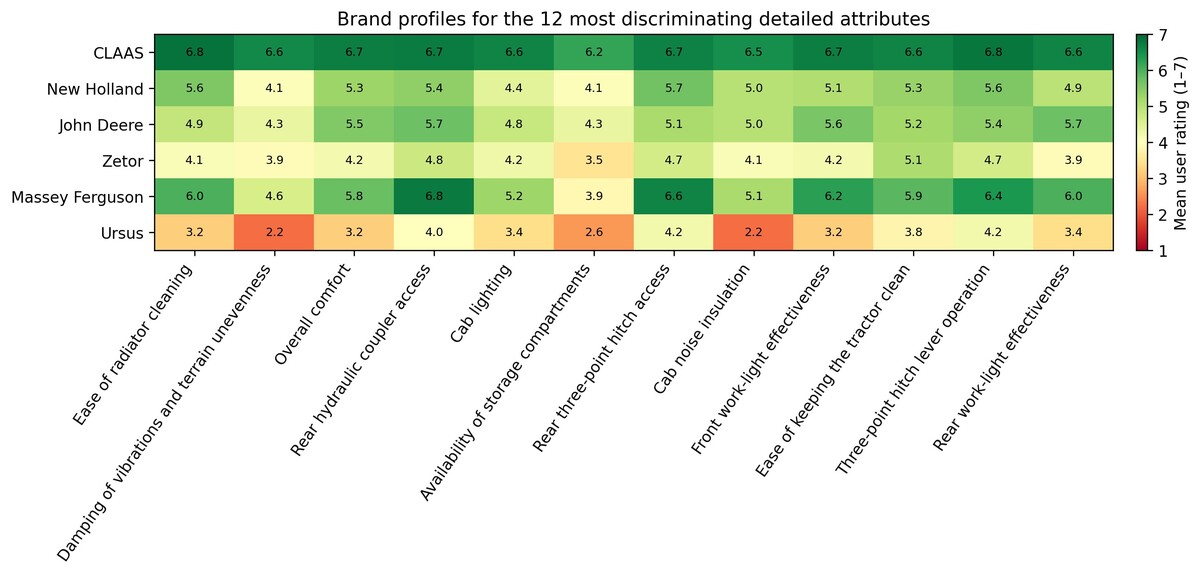
User experience with agricultural tractors is multidimensional and can be obscured by a single brand-level score. This study analysed 140 tractor-evaluation questionnaires covering 21 tractor brands and 44 detailed quality attributes rated on a seven-point scale. Descriptive analyses used the complete sample, whereas formal brand differentiation was restricted to six brands represented by at least five questionnaires (N = 108). Attribute-wise differences were evaluated by the Kruskal–Wallis test, epsilon-squared effect sizes, Benjamini–Hochberg false-discovery-rate correction, and stratified bootstrap confidence intervals. To test whether the 44-attribute profiles contained reproducible brand information beyond univariate contrasts, a shrinkage linear discriminant model was evaluated by stratified five-fold cross-validation and a label-permutation test. Spare-parts availability (6.26), engine reliability (6.16), and forward visibility (6.14) were the highest-rated attributes, whereas storage availability (4.64), passenger space (4.89), and vibration damping (4.94) were lowest. The strongest brand differentiation occurred for ease of radiator cleaning (ε² = 0.508), vibration damping (0.499), overall comfort (0.460), rear hydraulic-coupler access (0.448), and cab lighting (0.440). Cross-validated balanced brand-classification accuracy reached 0.371, compared with a six-class chance level of 0.167 (permutation p = 0.002). At model level, within-brand centering separated model-specific domain profiles from the corresponding brand baseline; 12 models represented by at least three users were visualized. The results show that practical tractor quality is structured by specific ergonomic, maintainability, reliability, and ownership attributes and that these detailed profiles contain reproducible information at both brand and model levels.
REFERENCES (11)
1.
Benjamini, Y., & Hochberg, Y. (1995). Controlling the false discovery rate: A practical and powerful approach to multiple testing. Journal of the Royal Statistical Society: Series B (Methodological), 57(1), 289–300. https://doi.org/10.1111/j.2517....
2.
Benos, L., Tsaopoulos, D., & Bochtis, D. (2020). A review on ergonomics in agriculture. Part II: Mechanized operations. Applied Sciences, 10(10), 3484. https://doi.org/10.3390/app101....
3.
Bovenzi, M., & Betta, A. (1994). Low-back disorders in agricultural tractor drivers exposed to whole-body vibration and postural stress. Applied Ergonomics, 25(4), 231–241. https://doi.org/10.1016/0003-6....
4.
Cankurt, M., & Miran, B. (2010). Tractor brand preferences of farmers: An analytic hierarchy process approach. Tarım Makinaları Bilimi Dergisi, 6(1), 13–17.
5.
Deboli, R., Calvo, A., & Preti, C. (2017). Whole-body vibration: Measurement of horizontal and vertical transmissibility of an agricultural tractor seat. International Journal of Industrial Ergonomics, 58, 69–78. https://doi.org/10.1016/j.ergo....
6.
Friedman, J. H. (1989). Regularized discriminant analysis. Journal of the American Statistical Association, 84(405), 165–175. https://doi.org/10.1080/016214....
7.
García-Alcaraz, J. L., Maldonado-Macías, A. A., Hernández-Arellano, J. L., Blanco-Fernández, J., Jiménez-Macías, E., & Sáenz-Díez Muro, J. C. (2016). Agricultural tractor selection: A hybrid and multi-attribute approach. Sustainability, 8(2), 157. https://doi.org/10.3390/su8020....
8.
International Organization for Standardization (ISO). (2026). Quality management — Fundamentals and vocabulary (5th ed.) (ISO 9000:2026). https://www.iso.org/standard/9....
9.
Kruskal, W. H., & Wallis, W. A. (1952). Use of ranks in one-criterion variance analysis. Journal of the American Statistical Association, 47(260), 583–621. https://doi.org/10.1080/016214....
10.
Ledoit, O., & Wolf, M. (2004). A well-conditioned estimator for large-dimensional covariance matrices. Journal of Multivariate Analysis, 88(2), 365–411. https://doi.org/10.1016/S0047-....
11.
Shin, S.-Y., Kang, C. H., Yu, S. C., Kim, B., Kim, Y.-Y., & Kim, J. O. (2014). Satisfaction with the quality of agricultural machinery and the propensity for replacement purchases. Journal of Biosystems Engineering, 39(4), 261–266. https://doi.org/10.5307/JBE.20....
Share
RELATED ARTICLE
| eISSN: | 2719-423X |
| ISSN: | 1642-686X |

We process personal data collected when visiting the website. The function of obtaining information about users and their behavior is carried out by voluntarily entered information in forms and saving cookies in end devices. Data, including cookies, are used to provide services, improve the user experience and to analyze the traffic in accordance with the Privacy policy. Data are also collected and processed by Google Analytics tool (more).
You can change cookies settings in your browser. Restricted use of cookies in the browser configuration may affect some functionalities of the website.
You can change cookies settings in your browser. Restricted use of cookies in the browser configuration may affect some functionalities of the website.