Current issue
Online First
Archive
Instructions for Authors
Guide for Authors
Peer Review Policy
Research Ethics Policy
Crossmark Policy
Ghostwriting and Guest Authorship
Copyright
Open Access Policy
Plagiarism
Preprints policy
About the Journal
Aim and Scope
Scientific Board
Publisher
Editorial Board
Indexing in Databases
Personal Data Protection
Repository Policy
AI Policy
Contact


REVIEW PAPER
Climate-Smart Agriculture and Multidimensional Food Security: A Systematic Review, Structural Equation Modeling, and Empirical Validation Using LSMS-ISA Data
1
Agricultural and Bio-Resources Engineering, Ahmadu Bello University, Nigeria
2
Agricultural Engineering, 3National Cereal Research Institute,, Nigeria
3
Production and dessimination, Agricultural Graduate Association of Nigeria (AGAN),, Nigeria
Submission date: 2026-05-12
Final revision date: 2026-09-16
Acceptance date: 2026-10-02
Online publication date: 2026-11-16
Corresponding author
Alisu Salisu IBRAHIM
Agricultural and Bio-Resources Engineering, Ahmadu Bello University, Samaru-Zaria, Zaria, Nigeria
Agricultural and Bio-Resources Engineering, Ahmadu Bello University, Samaru-Zaria, Zaria, Nigeria

KEYWORDS
ResilienceClimate ChangeFood SecurityStructural Equation ModelingClimate-Smart AgricultureAgri-food Systems
TOPICS
ABSTRACT
Abstract
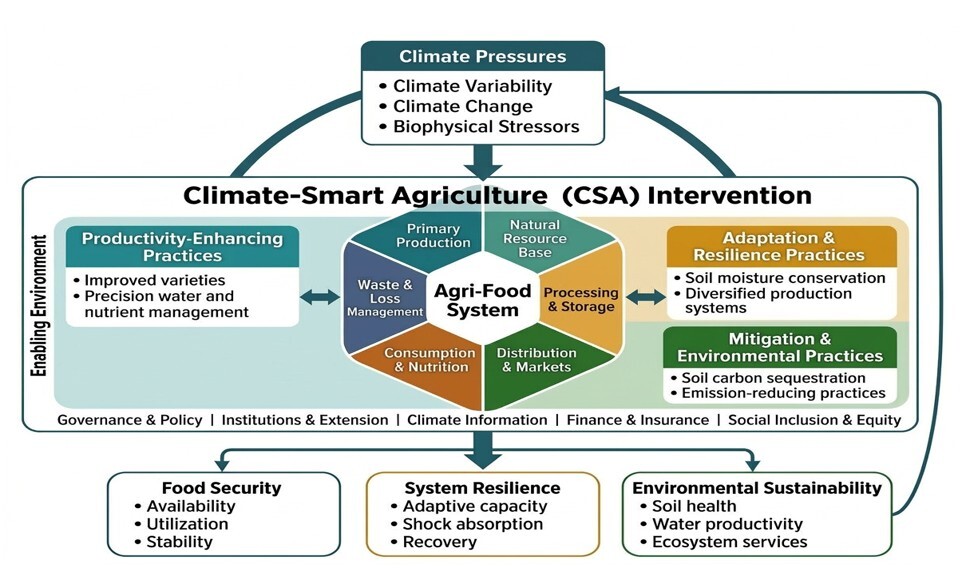
Climate change increasingly threatens agri-food systems, particularly in rain-fed agricultural regions where climatic shocks interact with institutional and socio-economic constraints. Climate-Smart Agriculture (CSA) is intended to improve productivity and resilience while supporting climate mitigation, yet evidence on its multidimensional food-security effects remains fragmented. This study integrates a PRISMA-based systematic review with an empirically tested structural framework linking climate stressors, CSA adoption, enabling conditions, productivity and adaptation pathways, and the four food-security dimensions. Forty-five studies were retained from 1,247 records identified through Scopus, Web of Science, and ScienceDirect searches. Semi-quantitative coding showed that productivity and food availability dominated the literature, whereas utilization was addressed in only 37.8% of studies and explicit system feedback in 26.7%. The empirical component used 4,872 households from the Nigeria General Household Survey–Panel Wave 5 (2023/24), with panel information from earlier waves used where available. Reported PLS-SEM estimates indicate positive associations between CSA adoption and food availability (β = 0.214), access (β = 0.156), utilization (β = 0.098), and stability (β = 0.183), all statistically significant at the 5% level or better. Institutional support was positively associated with CSA adoption (β = 0.312) and moderated the adaptation–stability relationship (β = 0.098, p = 0.020). Climate stress was negatively associated with availability and stability. The study contributes a more integrated, context-aware framework while recognizing that the available survey design limits strong causal inference and that environmental-sustainability mediation remains to be tested.
REFERENCES (25)
1.
Aggarwal, P. K., A. Jarvis, B. M. Campbell, R. B. Zougmoré, A. Khatri-Chhetri, S. J. Vermeulen, A. Loboguerrero, L. S. Sebastian, J. Kinyangi, O. Bonilla-Findji, M. Radeny, J. Recha, D. Martinez-Baron, J. Ramirez-Villegas, S. Huy-er, P. Thornton, E. Wollenberg, J. Hansen, P. Alvarez-Toro, A., B. Tan Yen.. (2018). The climate-smart village approach: Framework of an integrative strategy for scaling up adaptation options in agriculture. Ecology and Socie-ty, 23(1), 14. https://doi.org/10.5751/ES-098....
2.
Crumpler, K., S. Dasgupta, S. Federici, A. Meybeck, M. Bloise, V. Slivinska, M. Salvatore, et al. (2020). Regional Analysis of the Nationally Determined Contributions in Asia: Gaps and Opportunities in the Agriculture and Land Use Sectors. Environment and Natura Resources Management Working Paper 78, Food and Agriculture Or-ganization of the United Nations, Rome. DOI:10.4060/ca7264en.
3.
DFID. (1999). Sustainable livelihoods guidance sheets. Department for International Development. https://worldfish.org/GCI/gci_....
4.
Ericksen, P. J. (2008). Conceptualizing food systems for global environmental change research. Global Environmental Change, 18(1), 234–245. https://doi.org/10.1016/j.gloe....
5.
FAO. (2013). Climate-smart agriculture: Sourcebook. Food and Agriculture Organization of the United Nations. http://www.fao.org/docrep/018/....
6.
FAO, IFAD, UNICEF, WFP, & WHO. (2023). The state of food security and nutrition in the world 2023: Urbaniza-tion, agrifood systems transformation and healthy diets across the rural–urban continuum. FAO; IFAD; UNICE; WFP; WHO. https://doi.org/10.4060/cc3017....
7.
Folke, C. (2006). Resilience: The emergence of a perspective for social–ecological systems analyses. Global Environ-mental Change, 16(3), 253–267. https://doi.org/10.1016/j.gloe....
8.
Folke, C., Carpenter, S. R., Walker, B., Scheffer, M., Chapin, T., & Rockström, J. (2010). Resilience thinking: Integrat-ing resilience, adaptability and transformability. Ecology and Society, 15 (4), 20. https://ecologyandsociety.org/....
9.
Girma, G. T., & Petros, W. W. (2024). Indicators, theory of change and impact pathways in climate-smart agriculture for sustainable development: A systematic review. Agricultural Reviews, 45(1), 68–74. https://doi.org/10.18805/ag.RF....
10.
Hair, J. F., Hult, G. T. M., Ringle, C. M., & Sarstedt, M. (2022). A primer on partial least squares structural equation modeling (PLS-SEM) (3rd ed.). Sage.
11.
Henseler, J., Hubona, G., & Ray, P. A. (2016). Using PLS path modeling in new technology research: Updated guide-lines. Industrial Management & Data Systems, 116(1), 2–20. https://doi.org/10.1108/IMDS-0....
12.
HLPE. (2020). Food security and nutrition: Building a global narrative towards 2030. A report by the High Level Panel of Experts on Food Security and Nutrition of the Committee on World Food Security. FAO. https://www.fao.org/3/ca9731en....
13.
Holland, J. H. (2006). Studying complex adaptive systems. Journal of Systems Science and Complexity, 19(1), 1–8. https://doi.org/10.1007/s11424....
14.
Intergovernmental Panel on Climate Change (IPCC). (2022). Climate change 2022: Impacts, adaptation and vulnera-bility. Cambridge University Press. https://doi.org/10.1017/978100....
15.
Kurgat, B. K., Lamanna, C., Kimaro, A., Namoi, N., Manda, L., & Rosenstock, T. S. (2020). Adoption of climate-smart agriculture technologies in Tanzania. Frontiers in Sustainable Food Systems, 4,55. https://doi.org/10.3389/fsufs.....
16.
Lipper, L., Thornton, P., Campbell, B. M., Baedeker, T., Braimoh, A., Bwalya, M., Caron, P., Cattaneo, A., Garrity, D., Henry, K., Hottle, R., Jackson, L., Jarvis, A., Kossam, F., Mann, W., McCarthy, N., Meybeck, A., Neufeldt, H., Remington, T., ... Torquebiau, E. F. (2014). Climate-smart agriculture for food security. Nature Climate Change, 4(12), 1068–1072. https://doi.org/10.1038/nclima....
17.
National Bureau of Statistics. (2016). Nigeria General Household Survey Panel 2015-2016 Wave 3. World Bank Mi-crodata Library. https://microdata.worldbank.or....
18.
Omotayo, A. O., Olagunju, K. O., Ogunniyi, A. I., & Hounnou, F. E. (2025). Climate-smart agricultural practices and food-nutrition security outcomes: Insight from rural smallholder farmers. Agriculture & Food Security, 14(28), 1–19. https://doi.org/10.1186/s40066....
19.
Partey, S. T., Zougmoré, R. B., Ouédraogo, M., & Campbell, B. M. (2018). Developing climate-smart agriculture to face climate variability in West Africa: Challenges and lessons learnt. Journal of Cleaner Production, 172, 1997–2005. https://doi.org/10.1016/j.jcle....
21.
Rosenstock, T. S., Lamanna, C., Chesterman, S., Hammond, J., Kadiyala, S., Luedeling, E., Shepherd, K., DeRenzi, B., & van Wijk, M. T. (2017). When less is more: Innovations for tracking progress toward global targets. Current Opinion in Environmental Sustainability, 26–27, 54–61. https://doi.org/10.1016/j.cosu....
22.
Scoones, I. (1998). Sustainable rural livelihoods: A framework for analysis (IDS Working Paper 72). Institute of Devel-opment Studies. https://opendocs.ids.ac.uk/art....
23.
Walker, B., Holling, C. S., Carpenter, S. R., & Kinzig, A. (2004). Resilience, adaptability and transformability in social–ecological systems. Ecology and Society, 9(2), 5. https://doi.org/10.5751/ES-006....
24.
World Bank. (2016). Nigeria - General Household Survey, Panel 2015-2016. World Bank Microdata Catalog. https://doi.org/10.48529/7xmj-..., https://microdata.worldbank.or....
25.
World Bank. (2021). Climate-smart agriculture and food systems. World Bank Group. (access on: 15/10/2025) https://www.worldbank.org/en/t....
| eISSN: | 2719-423X |
| ISSN: | 1642-686X |

We process personal data collected when visiting the website. The function of obtaining information about users and their behavior is carried out by voluntarily entered information in forms and saving cookies in end devices. Data, including cookies, are used to provide services, improve the user experience and to analyze the traffic in accordance with the Privacy policy. Data are also collected and processed by Google Analytics tool (more).
You can change cookies settings in your browser. Restricted use of cookies in the browser configuration may affect some functionalities of the website.
You can change cookies settings in your browser. Restricted use of cookies in the browser configuration may affect some functionalities of the website.