Current issue
Online First
Archive
Instructions for Authors
Guide for Authors
Peer Review Policy
Research Ethics Policy
Crossmark Policy
Ghostwriting and Guest Authorship
Copyright
Open Access Policy
Plagiarism
Preprints policy
About the Journal
Aim and Scope
Scientific Board
Publisher
Editorial Board
Indexing in Databases
Personal Data Protection
Repository Policy
AI Policy
Contact


ORIGINAL PAPER
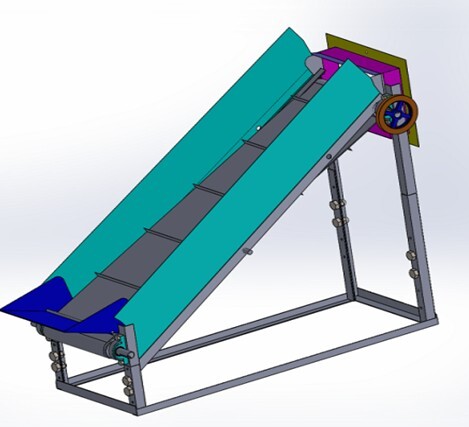
Design and Construction of a Conveyor System for an Engine-Driven Maize Sheller and Performance evaluation
1
Department of Agricultural Engineering research, Ethiopian Institution Agricultural centre, Ethiopia
Submission date: 2026-03-21
Final revision date: 2026-05-12
Acceptance date: 2026-05-19
Online publication date: 2026-07-02
Publication date: 2026-07-02
Corresponding author
Tasfaye Aseffa Abeye
Department of Agricultural Engineering research, Ethiopian Institution Agricultural centre, Adama University of Street, 1000, Adama, Ethiopia
Department of Agricultural Engineering research, Ethiopian Institution Agricultural centre, Adama University of Street, 1000, Adama, Ethiopia
Journal of Research and Applications in Agricultural Engineering 2026;71(1):85-96

KEYWORDS
TOPICS
ABSTRACT
Shelling is the process of separating maize kernels from the cob, and it can be performed manually or mechanically. The Melkassa-developed maize sheller is one of the mechanical types. It has high shelling performance, and it needs a high feed rate. Manual feeding of biomass was involved with high drudgery and consumption of time and energy. The objective of this study was the development of a conveyor feed for a Sheller to mitigate human drudgery and improve shelling performance. After development evaluation was conducted on Melkassa II after measuring engineering properties of mean head, intermediate, and tail diameters, 32 cm, 48 cm, and 25 cm were recorded, respectively. The study evaluated three levels of feed rates of 7000, 8000, and 9000 kg/h and speeds of 550, 650, and 750 rpm at 13 percent moisture content. As for the results, the conveyor feeding had a significant effect on shelling capacity (p < 0.05). The maximum shelling capacity is 7504.8 kg/h at an amount of biomass of 9000 kg/h and sheller speed of 750 rpm, and the minimum was recorded at 6140.9 kg/h feed rate with a 550 drum speed at 7000 kg/h. At a feed rate of 7000 kg/h) and speed 750 rpm the maximum seed breakage was 0.0174 percent, and the minimum was 0.0114 percent at speed 550 rpm and feed rate 9000 kg. The suggested adoption of a conveyor for the sheller improves shelling performance, ensures uniform feeding, minimizes drudgery, ensures a safe shelling operation, and enhances maize productivity.
REFERENCES (17)
1.
Abate, T., Shiferaw, B., Menkir, A., Wegary, D., & Kebede, Y. (2015). Factors that transformed maize productivity in Ethiopia. Food Sec. 7, 965–981. https://doi.org/10.1007/s12571....
2.
Abeye, T. A., Amhed, A. U., & Anewuteh, D. A. (2024). Performance Evaluation of the Melkassa - Made Engine - Driven Maize Sheller. 12(6), 136–141. DOI:10.11648/j.ijmea.20241206.11.
3.
Ahmed, M., Elmowla, A., Dahab, M. H., Rahman, F. El, & Mahie, A. E. L. (2017). Research paper Development of Feeding Conveyor in Grain Stationery Thresher. Nile Journal for Agricultural Sciences (NJAS), 02(01),74-88.
4.
Ali, A. M., Ali, A. A., & Abbas, B. A. (2024). Effect of shelling time and Sheller feeding rate of locally Sheller in some mechanical and physical traits of the process of Maize shelling. Kufa Journal for Agricultural Sciences, 16(1), 65–72. https://doi.org/10.36077/kjas/....
5.
Atere, A. O., Olalusi, A. P., Olukunle, O. J. (2016). Physical properties of some maize varieties. Journal of Multidisci-plinary Engineering Science and Technology (JMEST), 3(2), 3874–3880.
6.
Belay, D., & Fetene, M. (2021). The Effect of Moisture Content on the Performance of Melkassa Multicrop Thresher in Some Cereal Crops. Bioprocess Engineering, 5(1). https://doi.org/10.11648/j.be.....
7.
Dula, M. W. (2019). Review on Development and Performance Evaluation of Maize Sheller. International Journal of Engineering Research & Technology (IJERT), 8(05), 472–481.
8.
Gadisa, D. G., Kolhe, K. P., Busse, S. K., Issa, M. M., Abeye, T. A., & Alemu, D. (2025). Physical Property Characteri-zation of Ethiopian Maize Varieties for Adaptive Multi-Crop Planter Design. Journal of Agricultural Machinery, (), -. doi: 10.22067/jam.2025.92654.1356.
9.
Gebeyehu, S. G. (2023). Developing appropriate business model for maize shelling technologies in small holder farm-ers in North West Ethiopian Districts. Cogent Engineering, 10(1). https://doi.org/10.1080/233119....
10.
Igbinoba J.O, Unuigbe A.I.I, Akhere F.I, Ibhahe G.I, & Gbadamase V.I. (2019). Design and Fabrication of a Corn Sheller. Journal of Multidisciplinary Engineering Science and Technology (JMEST), 6(2), 1–10.
11.
Khurmi, R. S., & Gupta, J. K. (2005). A textbook of machine design (s.i. units) (first mult, vol. 1, issue i). Eurasia Publishing House (PVT.) Ltd.
12.
Matsagar, P. V. K., Ahire, B., Mandlik, A., More, B., & Thorat, D. (2022). Design and development of conveyor for agricultural application. International Research Journal of Modernization in Engineering Technology and Science, 04/05, 3995–4002.
13.
Miloradović, N., Vujanac, R., Miloradović, D., & Glišović, J. (2021). Determination of resistance to motion during operation of belt conveyor. Technics. Technologies. Education. Safety, VOL. 1.
14.
Mott, R. L. (1985). Machine elements in mechanical design. C.E. Merrill Publishing Company.
16.
Sharma, D.N., Mukesh, S. (2010). Farm machinery design: principles and problems (Second Edit). Jain Brothers.
17.
Tekeste, S., Degu, Y.M. (2020). Performance Evaluation of Motorized Maize Sheller. In: Habtu, N., Ayele, D., Fanta, S., Admasu, B., Bitew, M. (eds) Advances of Science and Technology. ICAST 2019. Lecture Notes of the Institute for Computer Sciences, Social Informatics and Telecommunications Engineering, vol 308. Springer, Cham. https://doi.org/10.1007/978-3-....
Share
RELATED ARTICLE
| eISSN: | 2719-423X |
| ISSN: | 1642-686X |

We process personal data collected when visiting the website. The function of obtaining information about users and their behavior is carried out by voluntarily entered information in forms and saving cookies in end devices. Data, including cookies, are used to provide services, improve the user experience and to analyze the traffic in accordance with the Privacy policy. Data are also collected and processed by Google Analytics tool (more).
You can change cookies settings in your browser. Restricted use of cookies in the browser configuration may affect some functionalities of the website.
You can change cookies settings in your browser. Restricted use of cookies in the browser configuration may affect some functionalities of the website.