Current issue
Online First
Archive
Instructions for Authors
Guide for Authors
Peer Review Policy
Research Ethics Policy
Crossmark Policy
Ghostwriting and Guest Authorship
Copyright
Open Access Policy
Plagiarism
Preprints policy
About the Journal
Aim and Scope
Scientific Board
Publisher
Editorial Board
Indexing in Databases
Personal Data Protection
Repository Policy
AI Policy
Contact


ORIGINAL PAPER
Assessment of Post-Harvest Losses in Key Staple and Vegetable Crops in Kano State, Nigeria

1
National Agricultural Extension & Research Liaison Services (NAERLS), Ahmadu Bello University, Zaria, Nigeria
2
Engineering Unit, Sasakawa Global (SG2000), Nigeria
Submission date: 2026-02-10
Final revision date: 2026-09-17
Acceptance date: 2026-09-22
Online publication date: 2026-11-02
Corresponding author
Taofiq Olayinka Olanrewaju
National Agricultural Extension & Research Liaison Services (NAERLS), Ahmadu Bello University, Zaria, Zaria, Nigeria
National Agricultural Extension & Research Liaison Services (NAERLS), Ahmadu Bello University, Zaria, Zaria, Nigeria
KEYWORDS
TOPICS
ABSTRACT
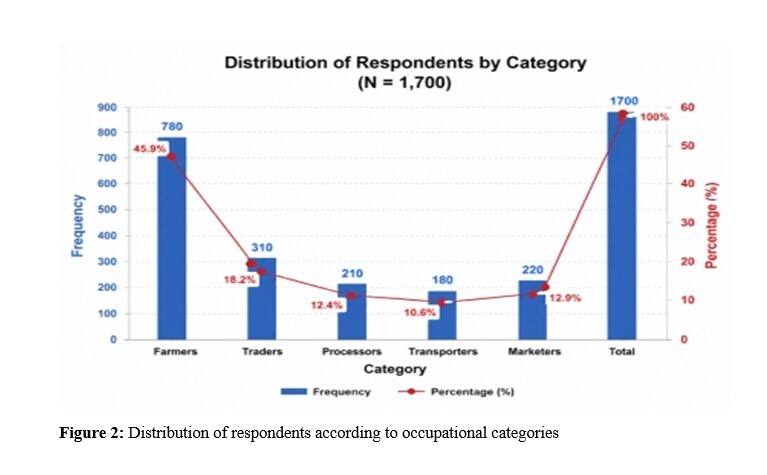
Post-harvest losses remain a major challenge to food security, farm income, and agricultural sustainability in northern production zones like Kano State, Nigeria. The magnitude, causes, critical loss points, and economic implications of post-harvest losses among rice, maize, sorghum, millet, tomato, cabbage, and onion was assessed in Kano State. Quantitative descriptive survey design was used; data were collected between May and October 2025, covering wet and dry agricultural production seasons from 1,700 respondents across 40 Local Government Areas using a structured questionnaire administered through Computer-Assisted Personal Interviewing with the Open Data Kit platform. Respondents estimated losses at storage, transportation, processing, marketing, and consumption stages as proportions of harvested or produce handling. Data were summarized using frequencies, percentages, means, and comparative descriptive statistics in SPSS Version 25. Tomato recorded the highest average storage loss (43.7%), transportation loss (41.3%), processing loss (37.7%), and marketing loss (38.3%). Onion recorded the highest average consumption-stage loss (34.0%). Major causes included insufficient storage capacity (77.38%), inadequate pest control (76.09%), poor warehouse management (74.80%), over-supply leading to spoilage (73.20%), and inadequate market information (71.36%). Percentage revenue losses were highest for cabbage (29.33%), tomato (27.61%), and onion (26.30%). In absolute monetary terms, maize recorded the largest average revenue loss (₦438,149.9), despite its lower percentage revenue loss of 13.99%. The findings indicate that perishable vegetables face the greatest proportional losses, while high-volume cereal production can generate substantial absolute economic losses even at lower percentage loss rates. The study recommends targeted improvements in storage, transportation, handling, market information, and supply-chain coordination.
REFERENCES (16)
1.
Abubakar, M., & El-Okene, M. I. A. (2015). Postharvest transit losses of tomato in different packaging unit in Nigeria. International Journal of Engineering Research & Technology, 4(8).
2.
Adeola, S. S., Salisu, J., & Folorunso, S. T. (2024). Nature, causes and stages of post-harvest losses in rice production in Kurfi Local Government Area of Katsina State. Nigerian Journal of Animal Production, 1536–1539.
3.
Affognon, H., Mutungi, C., Sanginga, P., & Borgemeister, C. (2015). Unpacking postharvest losses in sub-Saharan Af-rica: A meta-analysis. World Development, 66, 49–68. https://doi.org/10.1016/j.worl....
4.
Bello, M., & Yakubu, A. U. (2023). Examining the economic consequences of post-harvest losses in smallholder onion farming in Kano State, Nigeria. Journal of Agriculture and Environment, 19(1), 53–72.
5.
Central Bank of Nigeria (CBN) (2024). Annual economic report: Agriculture sector performance. Central Bank of Nige-ria. https://www.cbn.gov.ng.
6.
Falola, A., Mukaila, R., Uddın Iı, R. O., Ajewole, C. O., & Gbadebo, W. (2023). Postharvest Losses in Onion: Causes and Determinants. Kahramanmaraş Sütçü İmam Üniversitesi Tarım Ve Doğa Dergisi, 26(2), 346-354. https://doi.org/10.18016/ksuta....
7.
Gounga, M. E., Ado, R. I., & Boureima, S. (2023). Diagnostic study and assessment of post-harvest losses of some market garden products in the key production areas in Niger. International Journal of Innovation and Applied Studies, 38(4), 794–805.
8.
Gustavsson, J., Cederberg, C., Sonesson, U., Van Otterdijk, R., & Meybeck, A. (2011). Global food losses and food waste: Extent, causes and prevention. Food and Agriculture Organization of The United Nations.
9.
Ibrahim, H. I., Ibrahim, H. Y., Adeola, S. S., & Ojoko, E. A. (2022). Post-harvest loss and food security: A case study of major food crops in Katsina State, Nigeria. FUDMA Journal of Agriculture and Agricultural Technology, 8(1), 393–403. https://doi.org/10.33003/jaat.....
10.
Kitinoja, L., Saran, S., Roy, S. K., & Kader, A. A. (2011). Postharvest technology for developing countries: Challenges and opportunities in research, outreach and advocacy. Journal of the Science of Food and Agriculture, 91(4), 597–603. https://doi.org/10.1002/jsfa.4....
11.
Olanrewaju, T. O., Aliyu, A. M., Muhammad, A. A., & Qasim, A. O. (2026). Postharvest farm produce handling in Nigeria and its implication. UNIZIK Journal of Agricultural and Biosystems Engineering, 1(3), 90-106.
12.
Olayemi, F. F., Adegbola, J. A., Bamishaiye, E. I., & Daura, A. M. (2011). Assessment of post-harvest challenges of small-scale farm holders of tomatoes, bell and hot pepper in some local government areas of Kano State, Nigeria. Bayero Journal of Pure and Applied Sciences, 3(2), 39–42. https://doi.org/10.4314/bajopa....
13.
Parfitt, J., Barthel, M., & Macnaughton, S. (2010). Food waste within food supply chains: Quantification and potential for change to 2050. Philosophical Transactions of the Royal Society B, 365(1554), 3065–3081. https://doi.org/10.1098/rstb.2....
14.
Plaisier, C., Sibomana, M., Van der Waal, J., Clercx, L., Van Wagenberg, C. P. A., & Dijkxhoorn, Y. (2019). Approach for Designing Context-Specific, Locally Owned Interventions to Reduce Postharvest Losses: Case Study on Toma-to Value Chains in Nigeria. Sustainability, 11(1), 247. https://doi.org/10.3390/su1101....
15.
Suleiman, N. J., Abdulsalam, Z., Hassan, A. A., & Yakubu, L. L. (2024). Evaluation of postharvest losses in physical and economic perspectives along tomato value chain in Kano State, Nigeria. Journal of Agripreneurship and Sus-tainable Development, 7(2), 120–131. https://doi.org/10.59331/jasd.....
16.
Tafida, A., Michael, A., & Nandagoyang, M. (2022). Analysis of livelihood of rural irrigated crop farmers in Kano State, Nigeria. Problemy Rolnictwa Światowego, 22(2), 57–64. https://doi.org/10.22630/PRS.2....
Share
RELATED ARTICLE
| eISSN: | 2719-423X |
| ISSN: | 1642-686X |

We process personal data collected when visiting the website. The function of obtaining information about users and their behavior is carried out by voluntarily entered information in forms and saving cookies in end devices. Data, including cookies, are used to provide services, improve the user experience and to analyze the traffic in accordance with the Privacy policy. Data are also collected and processed by Google Analytics tool (more).
You can change cookies settings in your browser. Restricted use of cookies in the browser configuration may affect some functionalities of the website.
You can change cookies settings in your browser. Restricted use of cookies in the browser configuration may affect some functionalities of the website.