Current issue
Online First
Archive
Instructions for Authors
Guide for Authors
Peer Review Policy
Research Ethics Policy
Crossmark Policy
Ghostwriting and Guest Authorship
Copyright
Open Access Policy
Plagiarism
Preprints policy
About the Journal
Aim and Scope
Scientific Board
Publisher
Editorial Board
Indexing in Databases
Personal Data Protection
Repository Policy
AI Policy
Contact


ORIGINAL PAPER
Assessment and Improvement of Groundwater Vulnerability Mapping Using the DRASTIC Model in Wadi Shuaib Sub-Basin, Jordan
1
Water and Soil, National Agricultural Research Center NARC, Jordan
Submission date: 2025-10-07
Final revision date: 2025-12-23
Acceptance date: 2026-01-21
Online publication date: 2026-01-29
Publication date: 2026-07-01
Corresponding author
Journal of Research and Applications in Agricultural Engineering 2026;71(1):25-39

KEYWORDS
TOPICS
ABSTRACT
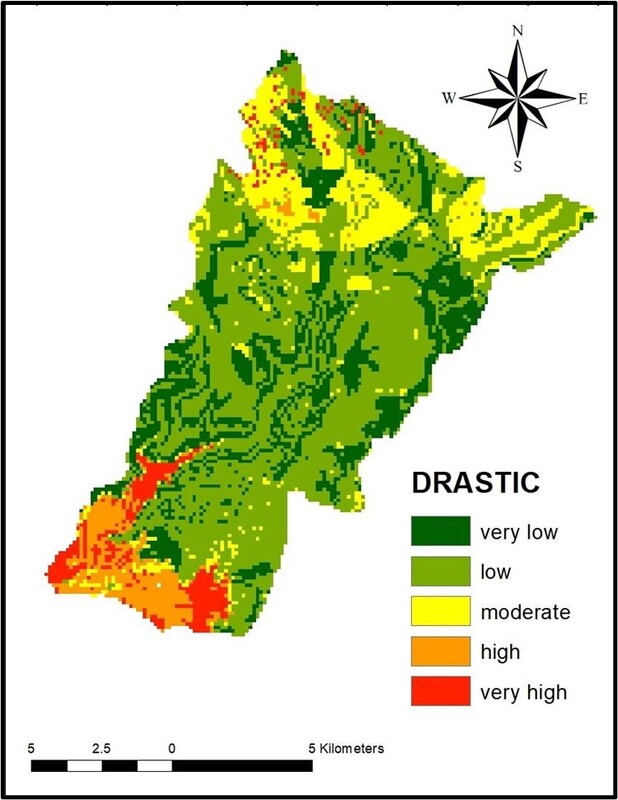
Jordan, an arid to semi-arid and extremely water-scarce country, relies heavily on groundwater, rendering the Wadi Shuaib sub-basin a critical yet vulnerable resource. Contamination threats from septic-tank leakage, overflows from the Assalt and Fuhais wastewater treatment plants, and diffuse agricultural pollutants necessitated assessing and refining groundwater vulnerability via the DRASTIC index in a GIS framework. The standard DRASTIC model, utilizing seven hydrogeological parameters from hydrological, geological, soil, land-use, and well data, produced a vulnerability map classifying the 172 km² basin into five categories: very low to very high. About three-quarters of the area exhibits low to very low vulnerability, while high (6%) and very high (5%) classes concentrate in the south-western sector, driven by shallow water tables (<1.5m), permeable alluvial Entisols, and focused recharge that accelerate contaminant percolation.
Validation employed a Groundwater Quality Index (GQI) for E. coli, nitrate, and turbidity against Jordanian drinking-water standards, revealing generally high GQI scores (90–99%) but post-storm deteriorations exactly in high-vulnerability zones. Sensitivity analysis (P-values <0.05, R²) highlighted the Impact of vadose zone, net recharge, hydraulic conductivity, and topography as key contaminant transport controls, warranting higher weights for these and lower weights for depth to water, soil media, and aquifer media. The optimized DRASTIC scheme enhanced alignment between vulnerability classes and GQI distributions, offering a realistic pollution risk portrayal, particularly in recharge hotspots. The resulting maps constitute a decision support tool for delineating wellhead protection areas, prioritizing monitoring, and guiding land use planning adaptable to other semi-arid basins via local calibration and water-quality validation.
REFERENCES (27)
1.
Abbassi B.E., Khrisat H. and Alnewashi, Q.: Municipal solid waste management at Salt City in Jordan: Community perspective. Journal of Food, Agriculture & Environment, 2009, 7(2), pp.740–745. Available at: https://www.wflpublisher.com/A....
2.
Al Kharabsheh N. and Al Kharabsheh A.: Influence of urbanization on water quality deterioration of Northern Wadi Shu′eib catchment area springs, Jordan. Jordan Journal of Earth and Environmental Sciences, 2014, 6(1), pp.29–35.
3.
Aller L., Bennett T., Lehr J.H., Petty R.J.: DRASTIC: A standardized system for evaluating groundwater pollution potential using hydrogeologic settings. 1987, EPA Report 600/2 87 035.
5.
Gonçalves V., Albuquerque A., Carvalho P., Almeida P. and Cavaleiro V.: Groundwater vulnerability assessment to cemeteries pollution through GIS based DRASTIC index. Water, 2023, 15(4), 812. https://doi.org/10.3390/w15040... .
6.
Hammour N. and El Naqa A.: GIS based hydrogeological vulnerability mapping of groundwater resources in Je-rash area–Jordan. Geofísica Internacional, 2008, 47(2), pp.85–97. https://doi.org/10.22201/igeof....
7.
Jiries A., Ta’any R., Abbassi B. and Oroud I.: Agriculture water use efficiency in Wadi Shu’eib area, Jordan. Polish Journal of Environmental Studies, 2010, 19(2), pp.317–324 .
8.
Khrisat, H.T.: Optimization of integrated solid waste management improvement scenarios for Salt City in Jordan using computer based decision support tool. Open Access Library Journal, 2022, 9, e8900. https://doi.org/10.4236/oalib.... .
9.
Khrisat H. T.: Risk assessment of drinking water using WSP for Azraq Spring Jordan. Open Access Library Journal, 2022, 9, e8899. https://doi.org/10.4236/oalib.... .
10.
Khrisat H.T. and Al Bakri J.: Assessment of groundwater vulnerability in Azraq catchment in Fuhais Jordan using DRASTIC model. Open Journal of Geology, 2019, 9, pp.364–377. https://doi.org/10.4236/ojg.20... .
11.
Khrisat H. T.: Impact of using different mulches on clay soil temperature, moisture, and saved water at AsSalt City-Jordan. Journal of Research and Applications in Agricultural Engineering, 2025, pp.1–7. https://doi.org/10.53502/jraae....
12.
Lakhdar Seraiche L., Dougha M., Ghodbane M., Selmane T., Ferhati A. and Djemiat D.E.: Groundwater vulnera-bility assessment in semi arid regions using GIS based DRASTIC models and FUZZY AHP: South Chott Hod-na. Desalination and Water Treatment, 2025, 323, 101380. https://doi.org/10.1016/j.dwt.... .
13.
Ministry of Water and Irrigation (MWI), National water master plan for Jordan, 2004. Amman: MWI .
14.
[15 ] Awawdeh M., Al-Kharabsheh N., Obeidat M., & Awawdeh M.: Groundwater vulnerability assessment using modified SINTACS model in Wadi Shueib, Jordan. Annals of GIS, 2020, 26(4), 377–394 https://doi.org/10.1080/194756... .
15.
Muhammad A.M., Zhonghua T., Dawood A.S. and Earl B.: Evaluation of local groundwater vulnerability based on DRASTIC index method in Lahore, Pakistan. Geofísica Internacional, 2015, 54(1), pp.67–81. https://doi.org/10.1016/j.gi.2....
16.
Rahmani Gh. R., Chitsazan M., Zaresefat M., Kalantari N. Evaluation of groundwater quality for drinking with GQI in Ize – Piyon plain. Fourth International Conference on Water Resources Management of Iran, 2011.
17.
Riepl D.: Knowledge based decision support for integrated water resources management with an application for Wadi Shueib, Jordan. PhD thesis, 2012, Universität Karlsruhe .
18.
Saidi S., Bouri S. and Ben Dhia H.: Sensitivity analysis in groundwater vulnerability assessment based on GIS in the Mahdia–Ksour Essaf aquifer, Tunisia: A validation study. Hydrological Sciences Journal, 2011, 56(2), pp.288–304. https://doi.org/10.1080/026266... .
19.
Singhal B.B.S. and Gupta R.P.: Applied hydrogeology of fractured rocks, 2nd ed. Dordrecht: Springer, 2010, ISBN-13:978-9048187980.
20.
Ta’any A.: Assessment of groundwater vulnerability to pollution sources at Salt urban area. MSc thesis, 2009, Al Balqa Applied University, Jordan.
21.
Ta’any R.: Hydrological and hydrochemical study of the major springs in Wadi Shu’eib catchment area. MSc the-sis, 1992, Yarmouk University, Jordan .
22.
Tesoriero A.J., Inkpen E.L. and Voss F.D.: Assessing ground water vulnerability using logistic regression. In: Proceedings of the Source Water Assessment and Protection Conference, Dallas, TX, 1998, pp.157–165 .
23.
Singhal B.B.S. and Gupta R.P.: Applied hydrogeology of fractured rocks, 2nd ed. Dordrecht: Springer, 2010, ISBN-13:978-9048187980,.
24.
Tomer T., Katyal D. and Joshi V.: Sensitivity analysis of groundwater vulnerability using DRASTIC method: A case study of National Capital Territory, Delhi, India. Groundwater for Sustainable Development, 2019, 9, 100271. https://doi.org/10.1016/j.gsd.....
25.
Zagana E., Obeidat M., Kuells C. and Udluft P.: Chloride, hydrochemical and isotope methods of groundwater recharge estimation in eastern Mediterranean areas: A case study in Jordan. Hydrological Processes, 2007, 21(16), pp.2112–2123. https://doi.org/10.1002/hyp.63....
26.
Babiker I.S., Mohamed M.A.A., Hiyama T.: Assessing groundwater quality using GIS. Water Resour. Manage, 2007, 21(4): 699 –715. https://doi.org/10.1007/s11269....
27.
Singh A., Srivastav S. K., Kumar S., & Chakrapani G. J.: A modified-DRASTIC model (DRASTICA) for assessment of groundwater vulnerability to pollution in an urbanized environment in Lucknow, In-dia. Environmental Earth Sciences, 2015, 74, 5475-5490. https://doi.org/10.1007/s12665....
CITATIONS (1):
1.
Climate-induced water variability and aquaculture resilience in Jordan's Dam Reservoir-dependent ecosystems:challenges and adaptive solutions
Hassan T. Khrisat, Ahmad Khrisat
Journal of Research and Applications in Agricultural Engineering
Hassan T. Khrisat, Ahmad Khrisat
Journal of Research and Applications in Agricultural Engineering
| eISSN: | 2719-423X |
| ISSN: | 1642-686X |

We process personal data collected when visiting the website. The function of obtaining information about users and their behavior is carried out by voluntarily entered information in forms and saving cookies in end devices. Data, including cookies, are used to provide services, improve the user experience and to analyze the traffic in accordance with the Privacy policy. Data are also collected and processed by Google Analytics tool (more).
You can change cookies settings in your browser. Restricted use of cookies in the browser configuration may affect some functionalities of the website.
You can change cookies settings in your browser. Restricted use of cookies in the browser configuration may affect some functionalities of the website.
