Current issue
Online First
Archive
Instructions for Authors
Guide for Authors
Peer Review Policy
Research Ethics Policy
Crossmark Policy
Ghostwriting and Guest Authorship
Copyright
Open Access Policy
Plagiarism
Preprints policy
About the Journal
Aim and Scope
Scientific Board
Publisher
Editorial Board
Indexing in Databases
Personal Data Protection
Repository Policy
AI Policy
Contact


ORIGINAL PAPER
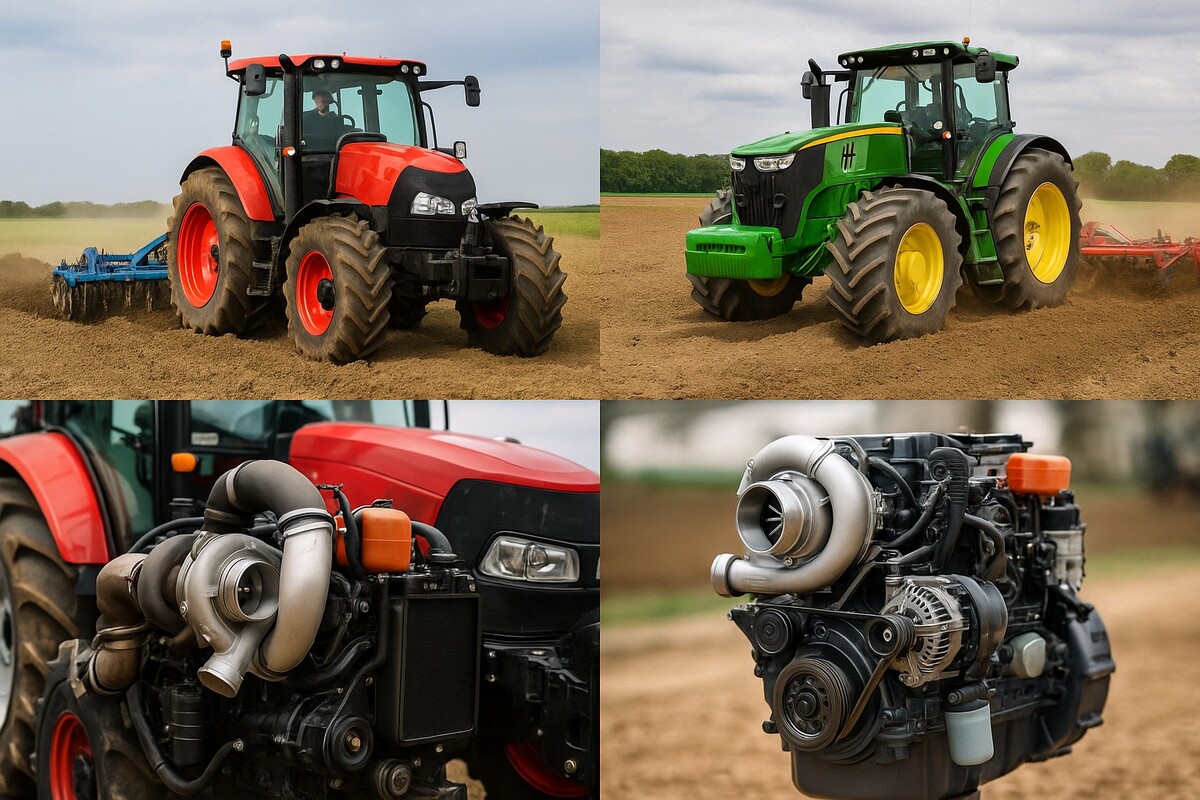
Future-oriented development of agricultural tractor engines: efficiency, modularity and powertrain electrification
1
Faculty of Environmental and Mechanical Engineering, Department of Biosystems Engineering, Poznań University of Life Sciences, Poland
Submission date: 2025-12-01
Final revision date: 2026-01-27
Acceptance date: 2026-01-30
Online publication date: 2026-02-05
Publication date: 2026-07-01
Corresponding author
Karol Durczak
Faculty of Environmental and Mechanical Engineering, Department of Biosystems Engineering, Poznań University of Life Sciences, Wojska Polskiego 50, 60-627, Poznań, Poland
Faculty of Environmental and Mechanical Engineering, Department of Biosystems Engineering, Poznań University of Life Sciences, Wojska Polskiego 50, 60-627, Poznań, Poland
Journal of Research and Applications in Agricultural Engineering 2026;71(1):40-48

KEYWORDS
tractor enginesdownsizingrightsizinghybridizationelectrificationmodularityenergy efficiencytrend analysis
TOPICS
ABSTRACT
The study analyses trends in the development of agricultural tractor engines in the context of technological and environmental transformation between 2015 and 2024, with forecasts up to 2035. Based on catalog data of over 150 tractor models and technical documentation from major manufacturers, changes in displacement, cylinder number, and specific power were evaluated. The aim of this study was to identify and quantitatively assess the key technological shifts in agricultural tractor engine design between 2015 and 2024, and to forecast their development pathways and potential impact on energy efficiency and sustainability up to 2035. The results indicate a continued transition from conventional downsizing to the rightsizing concept, with a simultaneous increase in average engine power by approximately 25% and a 10% reduction in displacement. Modular engine platforms have become dominant, enabling flexible configuration of four- and six-cylinder units and improving design unification. In the high-power segment, a renaissance of large-displacement engines optimized for low-speed efficiency was observed. Hybridization and electrification of powertrains are expected to increase their share to approximately 15% and 8%, respectively, by 2035, leading to a potential 10–20% reduction in fuel consumption and CO₂ emissions. The implementation of Smart Engine Management systems and advanced thermal control strategies contributes to improving thermal efficiency to approximately 43–45%. The obtained results provide a comprehensive overview of current and future engine development trends and may support decision-making processes related to sustainable and resource-efficient agricultural machinery design.
REFERENCES (18)
1.
CEMA. Agricultural machinery in Europe – Technology trends and sustainability outlook 2030. European Agricultural Machinery Association Report, Brussels, 2023.
2.
Bosch. Sustainable powertrain solutions for off-highway applications. Bosch Technical Report, Stuttgart, 2021.
3.
Reitz R.D., Duraisamy G.: Review of high-efficiency and clean combustion in diesel engines. Progress in Energy and Combustion Science, 2015, 46, 12–71. https://doi.org/10.1016/j.pecs....
4.
Aakko-Saksa P.T., Lehtoranta K., Kuittinen N., Järvinen A., Jalkanen J.-P., Johnson K., Jung H., Ntziachristos L., Gagné S., Takahashi C., Karjalainen P., Rönkkö T., Timonen H.: Reduction in greenhouse gas and other emissions from ship engines: Current trends and future options. Progress in Energy and Combustion Science, 2023, 94, 101055. https://doi.org/10.1016/j.pecs....
5.
Daszkiewicz P., Andrzejewski M., Medwid M.: Analysis of the selection of chosen technical parameters of the power-train system for a diesel-electric rail-road tractor. Combustion Engines, 2021, 186(3), 64–71. https://doi.org/10.19206/CE-14....
6.
Durczak K., Selech J.: The quantification of operational reliability of agricultural tractors with the competing risks method. Tehnički Vjesnik, 2022, 29(2), 628–633. https://doi.org/10.17559/TV-20....
7.
Durczak K., Selech J., Ekielski A., Żelaziński T., Waleński M., Witaszek K.: Using the Kaplan–Meier estimator to assess the reliability of agricultural machinery. Agronomy, 2022, 12, 1364. https://doi.org/10.3390/agrono....
8.
Durczak K., Ekielski A., Żelaziński T.: Calculation of the reliability function from actual failures resulting from the operation of one make of farm tractors. Journal of Research and Applications in Agricultural Engineering, , 2018 63(1), 18–22.
9.
Krzyżaniak K., Kowalik I.: Use of the telematics systems to technical service of tractors and agricultural machines. Journal of Research and Applications in Agricultural Engineering, 2022, 67(2), 21–26. https://doi.org/10.53502/RGVA4....
10.
Boniecki P., Krysztofiak A., Czechlowski M., Przybylak A.: Selected methods of artificial intelligence in the process of diagnosing of chosen agricultural tractors. Journal of Research and Applications in Agricultural Engineering, 2005, 50(2), 20–23.
11.
Wallington T.J., Woody M., Lewis G.M., Keoleian G.A., Adler E.J., Martins J.R.R.A., Collette M.D.: Hydrogen as a sustainable transportation fuel. Renewable and Sustainable Energy Reviews, 2025, 217, 115725. https://doi.org/10.1016/j.rser....
12.
Sokal K., Kachel M.: Impact of agriculture on greenhouse gas emissions—A review. Energies, 18, 2272, 2025. https://doi.org/10.3390/en1809....
13.
Durczak K., Rybacki P.: Noise emission in the cabs of modern farm tractors. Tehnički Vjesnik, 30(2), 669–675, 2023. https://doi.org/10.17559/TV-20....
14.
Durczak K., Rzeźnik C.: Systematyzacja wskaźników jakości pracy maszyn rolniczych. Journal of Research and Applications in Agricultural Engineering, 2005, 50(2), 24–29.
15.
Bor M., Idzior M., Karpiuk W., Smolec R.: Możliwości rozwoju silników spalinowych z uwzględnieniem strategii downsizingu i rightsizingu. AUTOBUSY – Technika, Eksploatacja, Systemy Transportowe, 2019, 24(6), 155–160. https://doi.org/10.24136/atest....
16.
Martins M.B., Conceição J.S., Marques Filho A.C., Alves B.L., Bertolo D.M.B., Seron C.C., Gomides J.F.F.B., Vendruscolo E.P.: Optimizing gear selection and engine speed to reduce CO₂ emissions in agricultural tractors. AgriEngineering, 2025, 7(8), 250. https://doi.org/10.3390/agrien....
17.
European Parliament and Council of the EU. Regulation (EU) 2016/1628 of 14 September 2016 on requirements relating to gaseous and particulate pollutant emission limits and type-approval for internal combustion engines for non-road mobile machinery. Official Journal of the European Union, 2016, L252, 53–117. https://eur-lex.europa.eu/eli/....
18.
Garcia E., Triantopoulos V., Trzaska J., Boehman A.L., Taylor M., Li J.: Development of a high thermal efficiency heavy-duty engine. Frontiers in Thermal Engineering, 2025, 4, 1517404. https://doi.org/10.3389/fther.....
Share
RELATED ARTICLE
| eISSN: | 2719-423X |
| ISSN: | 1642-686X |

We process personal data collected when visiting the website. The function of obtaining information about users and their behavior is carried out by voluntarily entered information in forms and saving cookies in end devices. Data, including cookies, are used to provide services, improve the user experience and to analyze the traffic in accordance with the Privacy policy. Data are also collected and processed by Google Analytics tool (more).
You can change cookies settings in your browser. Restricted use of cookies in the browser configuration may affect some functionalities of the website.
You can change cookies settings in your browser. Restricted use of cookies in the browser configuration may affect some functionalities of the website.
